

Buy First or Sell First? The Des Moines Move-Up Buyer's Most Stressful Question — Answered
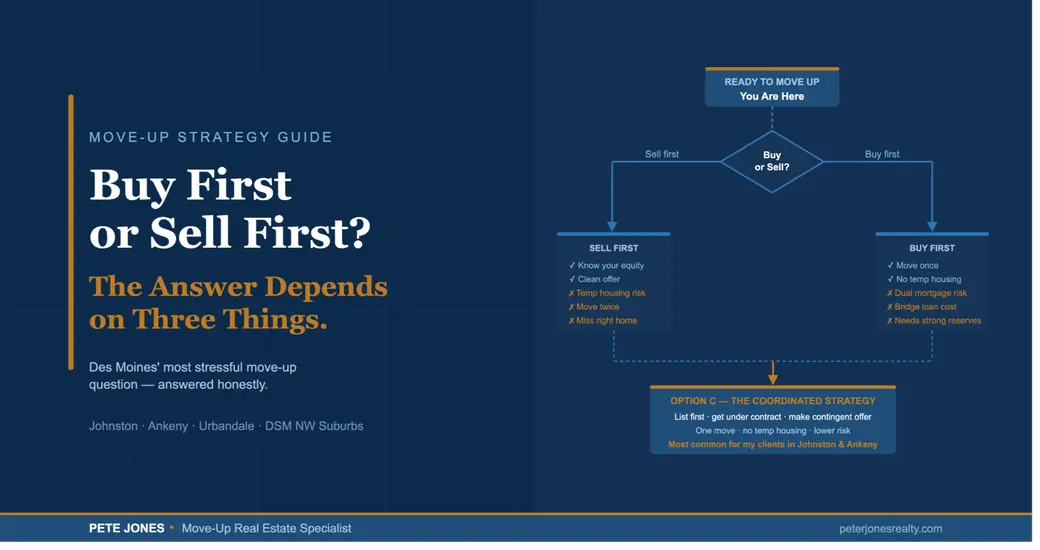
Buy first: risk carrying two mortgages. Sell first: risk having nowhere to go. Neither option feels comfortable. And yet every move-up family in Johnston, Ankeny, and Urbandale faces exactly this decision.
I manage both sides of this transaction simultaneously for every client I work with. Here is an honest breakdown of all three strategies - and the four variables that determine which one is right for you.
All Three Strategies at a Glance
| Factor | Sell First | Buy First | Coordinated Strategy |
|---|---|---|---|
| Dual mortgage risk | None | High | Low - if timed right |
| Temporary housing needed | Yes - likely | No | No |
| Move once | No - move twice | Yes | Yes |
| Offer competitiveness | Strong - no contingency | Strong - no contingency | Moderate - needs strategy |
| Financial certainty | High - know exact equity | Lower - two mortgages | High - sale under contract first |
| Best for | Flexible families with a good temp housing option | Strong finances, fast-selling home | Most move-up families in Johnston and Ankeny |
Option A: Sell First, Then Buy
How it works
You list your current home, accept an offer, and close. Your net proceeds are in your bank account. You then search for and purchase your next home with a non-contingent offer and full knowledge of your equity.
The pros
- Zero dual mortgage risk - you know exactly what you net before committing to a purchase
- Your offer on the next home is non-contingent - more competitive in multiple-offer situations
- No bridge loan costs or interest carry
- Maximum financial certainty before you commit
The cons
- You likely need 30-60 days of temporary housing - with kids, pets, and furniture in between
- Moving twice costs $4,000-$10,000 more and is significantly more disruptive for school-age children
- The right home in your target area may not be available when you are ready to buy
- Emotional pressure of a compressed buying timeline after the sale closes
When it makes sense
Selling first is the right call when inventory in your target area is healthy, you have a flexible or low-cost temporary housing option, or you are making a significant suburban move where coordinating both timelines precisely is genuinely difficult.
Johnston and Ankeny reality check: Well-priced homes in these suburbs go under contract in 7-14 days. If you sell first without an active search already underway on the buy side, you risk a very compressed - and stressful - buying window.
Option B: Buy First, Then Sell
How it works
You find and purchase your next home before listing your current one - either by qualifying for two mortgages simultaneously, or using a bridge loan to fund the down payment before your current home sells.
The pros
- Move directly from your old home to your new one - no temporary housing, no double move
- More time to find the right home without the pressure of a pending sale deadline
- Kids experience one school transition, not two
- Flexibility to negotiate from a position of certainty on the buy side
The cons
- Requires qualifying for two mortgage payments simultaneously - or a bridge loan at 1-2% origination plus a higher short-term rate
- Significant financial pressure if your current home sits longer than expected
- Most families in the $150K-$250K income range can qualify, but the financial cushion needs to be real - not theoretical
When it makes sense
Buying first works when you are in a strong financial position with documented reserves, your income fully supports two mortgage payments for 60-90 days, your current home is in excellent condition and priced to sell within 30 days, and your lender confirms you qualify without the sale proceeds.
Watch Out for This Assumption
"Our house will sell in a week." Maybe. But in a buy-first scenario, if it takes 45 days instead of 10, you are carrying two mortgages for 35 extra days. Know your break-even point before you commit to this strategy.
Option C: The Coordinated Contingent Strategy - Most Common for My Clients
How it works
You list your current home first and get it under contract. Your purchase offer on the new home includes a home-sale contingency - your purchase depends on your current sale closing. You work to compress the timeline on both sides so the gap between closings is days, not weeks.
Why this works in Johnston and Ankeny
Well-priced, well-prepared homes in Johnston and Ankeny sell within 7-14 days. When I list your current home, we have already done the pre-listing preparation, the pricing analysis, and the buy-side homework - so by the time you go under contract on the sale, you are ready to move on the purchase immediately.
The contingency window we request is 21-28 days - short enough to be credible to the seller, long enough to coordinate closings cleanly.
The strategic elements that make contingent offers competitive
- Current home already under contract before the offer is written - the strongest possible contingent position
- Pre-inspection documentation showing your current home will close cleanly - removes the seller's biggest concern
- Updated pre-approval letter showing you qualify independently if needed - signals financial strength
- Shortened contingency window of 14-21 days - demonstrates confidence in your sale timeline
- Competitive offer price or an escalation clause to offset the contingency concern
The Bottom Line on Option C
This is the strategy that works for most of the move-up families I work with in Johnston and Ankeny. One move. No temporary housing. Manageable risk. But it only works when both sides of the transaction are managed simultaneously by someone who knows what they are doing.
Option D: The Seller Leaseback - A Fourth Strategy Worth Knowing
Sometimes the cleanest solution is a seller leaseback negotiated at closing on your current home. Your buyers own the home at closing, but you remain as a tenant - typically for 30-60 days - while you close on your new property. In exchange, you may accept a slightly lower sale price or include a per-diem rent payment.
Buyers in competitive markets frequently agree to leasebacks, especially when they do not need immediate occupancy. This gives you extra runway to close on your new home without any temporary housing disruption - and is worth exploring in every transaction where the timing is tight.
The Four Variables That Determine the Right Strategy for You
The correct approach depends on your specific situation across four dimensions:
Your current home's marketability. A well-prepared, correctly priced home in Johnston or Ankeny moves in 7-14 days. A home that needs work or is priced optimistically may sit for 30-60. Honest assessment of your home's condition and correct pricing is the foundation of every strategy.
Your financial position. Can you carry two mortgages for 60-90 days if needed? Do you have bridge loan access? Do you have 3-6 months of reserves post-close? The stronger your financial cushion, the more flexibility you have.
Inventory in your target area. When 4-bedroom homes with 3-car garages in the right school district are limited, moving too slowly on the buy side means missing. When inventory is more available, sequencing matters less.
Your family's flexibility. Some families can absorb 30-60 days of temporary housing without major hardship. Others - with multiple kids in school, demanding careers, and tight timelines - cannot. There is no wrong answer. There is only the right answer for your situation.
I map out all four of these variables in our first meeting - so you walk away with a clear strategy, not just more anxiety about which path to choose.
Want to figure out the right sequencing for your move?
I map out the buy-first vs. sell-first strategy for every client before we start - based on your specific home, your financial position, and inventory in your target neighborhood. Start with the free Move-Up Guide.
Get the Free Move-Up GuideRelated Reading
Frequently Asked Questions
Should I buy my next house or sell my current house first in Des Moines Iowa?
For most Des Moines move-up buyers, the coordinated contingent strategy works best: list your current home, get it under contract, then make a contingent offer on the new home with a compressed contingency window. This avoids temporary housing and dual mortgage risk. Buying first is viable with strong financial reserves and a fast-selling current home. Selling first is safest financially but typically requires 30-60 days of temporary housing. The right choice depends on your financial position, your current home's marketability, and inventory in your target area.
How do you avoid paying two mortgages when moving up in Des Moines?
The most effective strategies: (1) Use a contingent offer - your purchase is contingent on your current sale closing first. (2) Negotiate a seller leaseback on your current home - stay as a tenant for 30-60 days after closing while you close on the new property. (3) Coordinate closing dates within 1-5 business days using aligned title companies. A move-up specialist who manages both transactions simultaneously is essential for all three approaches.
Does a contingent offer work in Johnston and Ankeny Iowa?
Yes. Contingent offers are accepted regularly in Johnston and Ankeny when presented strategically: your current home is already on the market or under contract, the contingency window is shortened to 14-21 days, your financial qualification is strong, pre-inspection documentation shows your current home will close cleanly, and your offer is competitive on price. A move-up specialist familiar with these markets knows how to structure and present contingent offers persuasively.
How long does a coordinated move-up transaction take in Des Moines?
A well-executed coordinated move-up transaction in Johnston, Ankeny, or Urbandale typically takes 3-5 months from initial consultation to moving in. The sequence: pre-listing preparation (4-6 weeks), active on market and under contract (7-21 days), purchase offer and new home under contract (within days of sale going under contract), coordinated closings (30-45 days after contracts). Families who prepare both sides of the transaction simultaneously consistently achieve this timeline.
Categories
Recent Posts






Peter Jones Realty
Phone